Framework Note / Metrics Guide — Version 1.0 (April 2026)
The QIM Metrics Overview outlines the core structural, behavioural, contextual, and swing‑integrity metrics that power the Quantum Interpretive Model. These metrics translate raw market data into interpretable system states, forming the foundation for QIM’s neutral analytical map. Designed to be non‑predictive and market‑agnostic, the metrics ensure consistent interpretive behaviour across global indices and benchmark Indian indices. Together, they establish the measurement framework that supports QIM’s structural‑behavioural approach and its emphasis on human judgement.
1. Introduction
The QIM Framework relies on a structured set of metrics that translate raw market data into interpretable system states. These metrics do not forecast outcomes; instead, they provide a quantum‑inspired interpretive layer that supports human judgment and situational awareness.
QIM metrics are engineered to be:
- Non‑predictive
- Structure‑first
- Behaviourally sensitive
- Context‑aware
- Market‑agnostic
These principles ensure that QIM remains consistent, scalable, and neutral across market environments.
2. Metric Categories
QIM metrics are organized into four primary categories, each serving a distinct interpretive role.
a. Structural Metrics
Structural metrics identify the underlying state of the market system. They form the backbone of QIM’s interpretive logic.
Key structural states include:
- Compression
- Expansion
- Imbalance
- Structural drift
- Structural anchoring
These states help determine the system’s current configuration and potential structural pathways.
b. Behavioural Metrics
Behavioural metrics quantify the intensity and direction of market behaviour. They capture how participants respond to structural conditions.
Examples include:
- Volume‑driven transitions
- Sentiment gradients
- Behavioural acceleration
- Behavioural exhaustion
These metrics help assess the strength and sustainability of market behaviour.
c. Contextual Metrics
Contextual metrics map structural and behavioural patterns to the prevailing market environment.
They capture:
- Macro alignment
- Sectoral reinforcement
- Cross‑index resonance
- Temporal context
Contextual metrics ensure that QIM’s interpretation remains grounded in broader market dynamics.
d. Swing Integrity Metrics
Swing integrity metrics validate the continuity and coherence of market swings.
They include:
- Swing fidelity
- Swing continuity
- Swing degradation
- Swing restoration
These metrics ensure that QIM’s analytical map remains structurally consistent over time.
3. Metric Integration
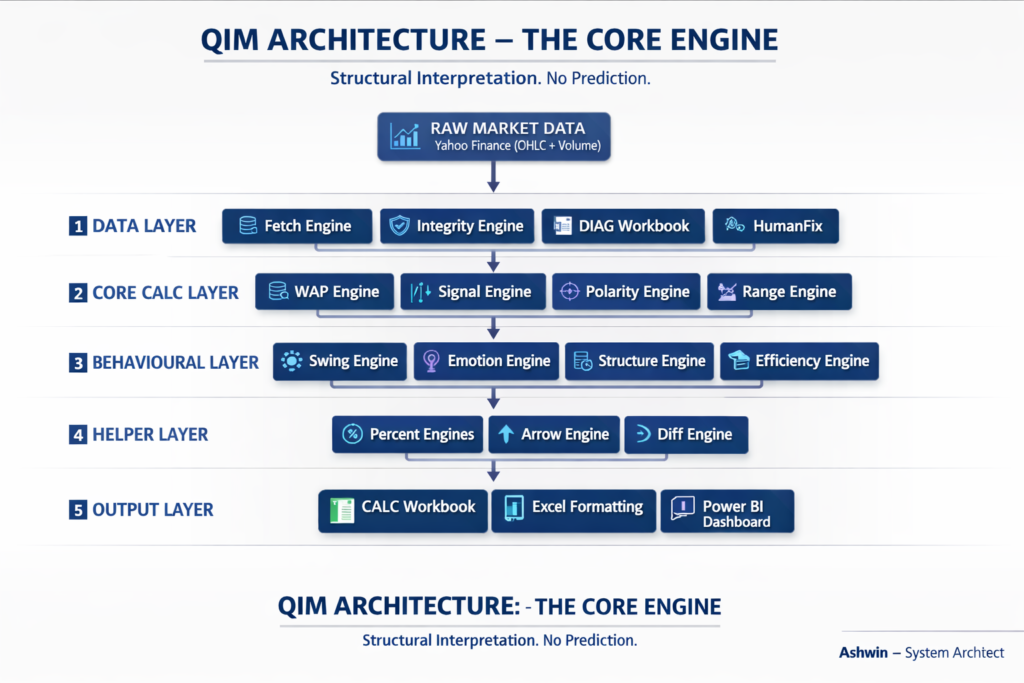
QIM does not treat metrics in isolation. Instead, it integrates them through a layered interpretive engine:
- Structural state identification
- Behavioural intensity evaluation
- Contextual alignment mapping
- Swing integrity validation
This integration produces the neutral analytical map that defines QIM’s interpretive output.
4. Universality Across Markets
QIM metrics are intentionally designed to be:
- Universal across global indices
- Consistent across benchmark Indian indices
- Scalable across timeframes
- Independent of asset‑specific noise
This universality ensures that QIM behaves predictably across diverse market structures and geographies.
5. Closing Note
The QIM Metrics Overview forms the foundation for upcoming framework notes that will detail each metric category, its interpretive role, and its integration into the QIM engine. These metrics are central to QIM’s mission: enabling structural‑behavioural interpretation without prediction.
© 2026 QIM Framework. All rights reserved. Proprietary Research Material.
Website: https://qimframework.com